A Data Center Is Coming to Cobb County. Here’s What Homeowners Should Know
If you’ve been following me on social media lately, you’ve probably noticed I’ve been sharing quite a few news stories about data centers being proposed and approved across Georgia.
The reason is simple: this is happening fast and worth following.
Right now, there are dozens of data centers either under construction or in the planning stages across Metro Atlanta. Many residents feel these projects are moving forward with little public awareness until decisions have already been made. Whether you support them, oppose them, or simply want more information, I think it’s important that homeowners understand what’s happening in their communities.
I’ll be honest. I’m not anti-technology.
I use AI in my business almost every day. It’s helpful for staging ideas, marketing, content creation, and analyzing real estate trends. It hasn’t completely transformed the way I work, but it has absolutely made me more productive and helped me think differently about my business.
So I’m not approaching this conversation as someone who thinks data centers are inherently bad.
What I do care about is how these projects affect our environment, our quality of life, our infrastructure, and, of course, our property values. As a Realtor, those are the questions my clients are asking, and they’re questions worth exploring.
Today, let’s take a look at the data center recently approved in Marietta.
What Is Being Built?
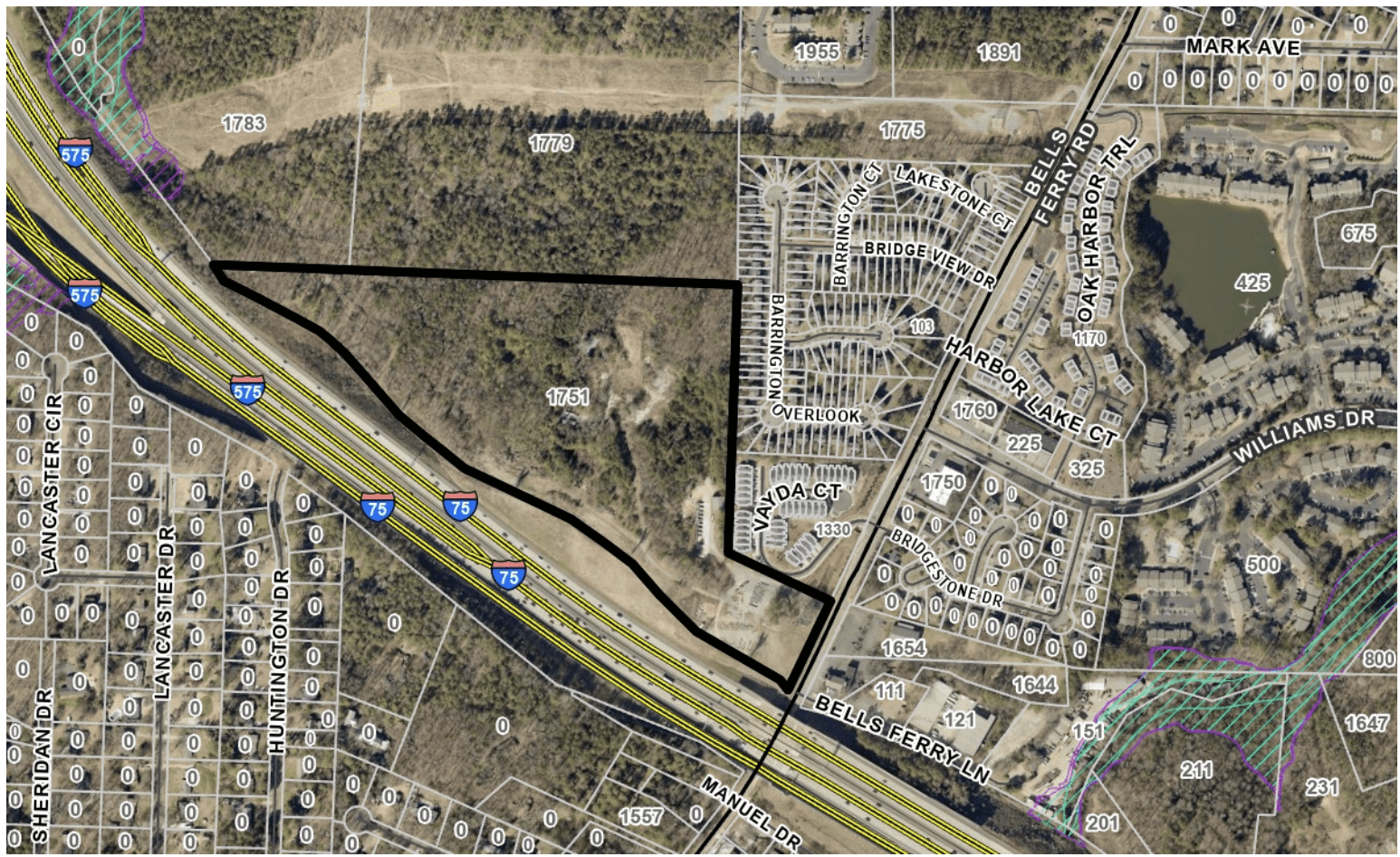
In June 2025, the Marietta City Council unanimously approved a data center campus on approximately 31 acres along Bells Ferry Road near Interstate 75.
The project will include:
- Two data center buildings totaling roughly 347,000 square feet
- A 4-acre electrical substation
- Buildings reaching up to 105 feet in height
- Stormwater management facilities
- Relocation of the existing cell tower currently located on the property
The facility is expected to require approximately 108 megawatts of electrical capacity, making it one of the larger proposed data center projects in the region.
Why Was This Site Chosen?
According to planning documents, the location offers several advantages:
- Close proximity to Interstate 75
- Existing utility infrastructure
- Access to major power transmission lines
- A large undeveloped parcel capable of supporting industrial-scale development
In other words, from a developer’s perspective, the site checks many of the boxes needed to support a project of this size.
Will It Affect Residential Property Values?
This is the question I care about most as a Realtor, and it’s probably the question most homeowners care about too.
The honest answer is that we don’t know yet.
Every market reacts differently, and there isn’t enough local data to confidently predict the outcome.
Potential concerns include:
- The industrial nature of the development
- Visual impacts from large buildings and supporting infrastructure
- Noise from cooling equipment and backup generators
- Buyer perception
Personally, I think the closest comparison may be homes located near major power transmission lines.
Historically, homes near highly visible power lines can experience a discount compared to similar homes farther away. Depending on visibility, location, and market conditions, that discount can range from minimal to significant. When power lines are screened by trees or other structures, buyer resistance tends to decrease.
I suspect the same could be true here.
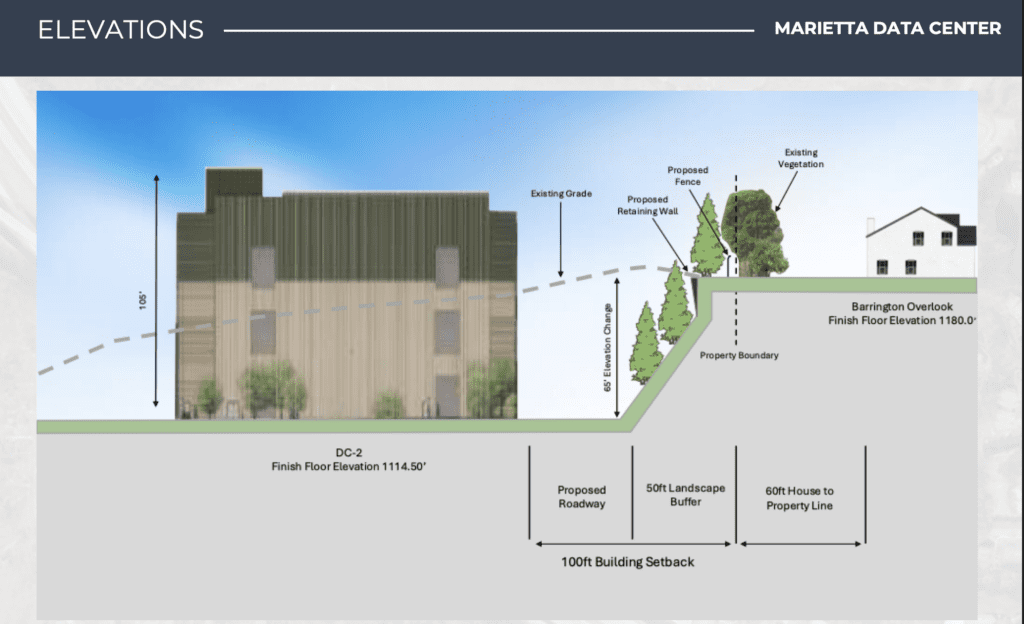
According to the planning documents (pg.10) the finished floor elevation of the Data Center buildings is 65 feet lower than the adjacent residential lots, the buildings, though 105 feet tall, will appear only 40 feet above the finish floor elevation of the Barrington Overlook homes. Given that the City of Marietta permits industrial buildings up to 50 feet tall by code,the proposed height variance will not result in a greater visual impact on the Barrington Overlook residential properties than a typical code-compliant industrial
There are also potential positives.
Supporters point to:
- Increased tax revenue
- Infrastructure improvements
- Additional commercial investment
- Economic growth
The reality is that both things can be true at the same time.
Will My Electric Bill Increase?
There is currently no evidence that this project alone will directly increase residential electric rates.
However, data centers consume enormous amounts of electricity, and utility providers across Georgia are evaluating how to meet rapidly growing demand from data centers.
The developer has stated that a dedicated substation will be constructed to support the project. Public discussions have referenced significant upfront investments in electrical infrastructure.
What remains unclear is how future regional infrastructure upgrades may affect long-term utility costs throughout Georgia.
What about Water Usage?
The project is expected to utilize a closed-loop cooling system, which generally uses less water than some traditional cooling methods.
City officials have indicated that adequate water capacity exists to serve the development.
What has not been publicly detailed is the facility’s projected long-term water consumption.
As more data centers are proposed throughout Georgia, water usage is becoming an increasingly important part of the conversation, particularly during periods of drought or rapid population growth.
Were Environmental Studies Conducted?
This is where things get interesting.
Based on publicly available planning documents, no independent environmental impact study or health impact assessment was required as part of the rezoning process.
That doesn’t mean environmental concerns were ignored.
The city reviewed stormwater plans, landscaping requirements, site grading, utility infrastructure, and land-use compatibility.
However, a comprehensive environmental impact study does not appear to have been conducted before approval.
For many residents, that’s one of the biggest concerns.
Questions about long-term energy consumption, noise, water resources, and land use are difficult to answer without that type of analysis.
My Take
Data centers aren’t going away.
They are becoming a critical part of our economy and the technology we all use every day.
At the same time, communities deserve transparency about the tradeoffs.
For homeowners near Bells Ferry Road, I think the biggest things to watch over the coming years will be:
- The final site design
- Noise mitigation measures
- Landscaping and visual buffers
- Infrastructure improvements
- Utility demand
- The local housing market’s response once construction begins
I don’t think every data center is automatically good or automatically bad. I do think residents deserve good information so they can make informed decisions about the future of their communities.
As more details emerge, I’ll continue sharing what I learn.
If you’re considering buying or selling in Cobb, Cherokee, Fulton, or Forsyth County and want to talk through how local development projects may affect your home’s value, I’d be happy to help.
Call or text me at 617-605-5939 or schedule a no-pressure 30-minute consultation below.
June 8, 2026


Be the first to comment