Moving to East Cobb, GA: An Honest Local Real Estate Agent’s Guide
By Alison Belknap / Compass Real Estate
If you have started Googling “East Cobb GA,” you have probably noticed every blog says basically the same three things. Great schools. Family friendly. Easy access to Atlanta. All true. None of it actually tells you what living here is like.
My favorite thing about living in East Cobb is how quickly you can put down roots here. When we relocated from the Boston area, we felt connected to the community almost right away, which made the move so much easier on all of us. You’ll meet neighbors from every walk of life, from other states, and from other countries. It’s the kind of place where finding your people happens naturally.
Where exactly is East Cobb, GA?
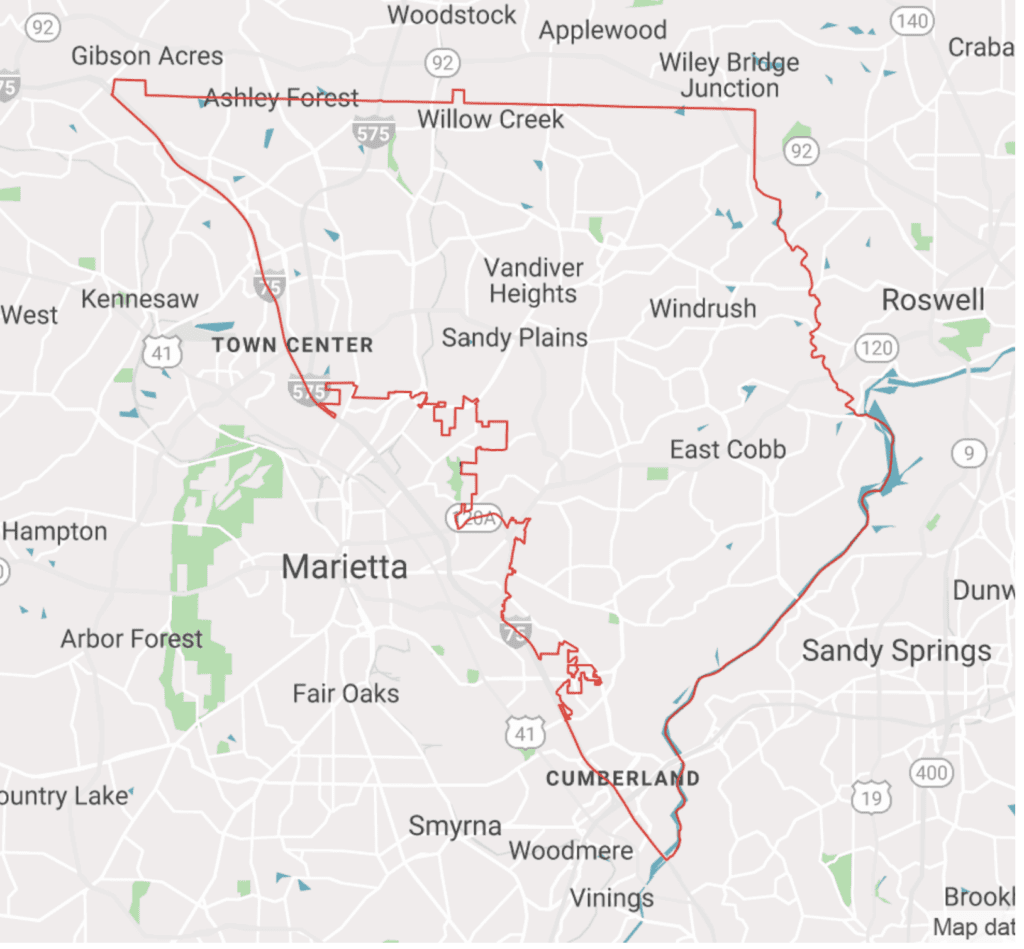
Ahh yes. This big question. This trips people up. East Cobb is not a city. It is a chunk of unincorporated Cobb County, which means addresses here can read Marietta or Roswell, depending on the zip code. When out of state buyers tell me they want “East Cobb,” they usually mean the area roughly bounded by the Chattahoochee River to the east, Roswell Road to the west, Lower Roswell to the south, and Shallowford Road to the north. Roughly. The boundaries are fuzzy and locals will absolutely argue with you about them.
If your relocation paperwork or your kids’ school registration asks for a city, you will likely write Marietta. That confuses some people but welcome to North Atlanta geography.
What you may NOT know about East Cobb
One of East Cobb’s quiet wins is the tax bill. Cobb County’s effective property tax rate is 0.69%, lower than Georgia’s statewide 0.77% and the lowest in the Atlanta Regional Commission’s 11-county area. Compare that to Fulton County’s effective rate of 1.16%, and the difference shows up fast. On a $500,000 home, you’re looking at roughly $3,450 a year in Cobb versus about $5,800 in Fulton. That’s around $2,350 more every year, or nearly $200 a month, for the same priced home just across the county line. Over ten years, that’s $23,000 staying in your pocket
You probably know that East Cobb is a family-forward community. Which means it’s not the most exciting spot for singles. The social fabric revolves around schools, swim/tennis neighborhoods, and kids’ activities, so if you’re flying solo and looking for nightlife or a built-in social scene, you’ll likely find yourself heading to nearby Roswell, especially Canton Street, which has a great nightlife and social scene. Buckhead, Sandy Springs, and Alpharetta are also close by and solid options for anyone who likes to be out past 9:00 pm.
If you’re actively looking homes, you’ll notice the majority of East Cobb’s housing stock was built between the 1980s and early 2000s. With homes from that era, it’s worth keeping an eye out for copper pipes, which can develop pinhole leaks. It’s a notorious issue here and can be costly to fix. Not every home has the problem, but enough do that it’s worth checking. The Cobb County-Marietta Water Authority traced the cause to sloppy soldering by the original plumber, not the water or the pipes themselves. Fixes range from patching a section to repiping the whole house. When you’re under contract, ask your inspector to flag any visible copper pipe corrosion, green staining, or signs of past leak repairs.
Another thing to know about East Cobb is that many of the homes are in HOA swim/tennis neighborhoods.. A lot of buyers love them because you meet people quickly and the kids stay busy from day one. That said, some buyers don’t love the rules and regulations that come with HOA living, or the annual fees, which can range from around $500 to $2,000 per year depending on the amenities the association manages.
Lastly, the demand in East Cobb is very high and homes sell fast. Especially homes located in the Walton or Pope High School district. If they’re renovated, well priced, and in a great neighborhood, they’re still going under contract in single digit days and usually above asking.
How is the commute from East Cobb to Atlanta?
If you work in Buckhead, plan thirty to forty five minutes. Downtown, add ten or fifteen. Honestly though, the local traffic matters more than the Atlanta commute.
You have may have heard about the Johnson Ferry and Shallowford intersection. There is a reason. According to GDOT, that intersection saw 129 crashes between 2019 and 2023, with 71 listed as congestion induced. Cobb County and Georgia DOT have approved a roughly $2.7 million project to reconfigure it. If you are touring homes near this intersection, that work is going to affect your daily life one way or another for the next few years.
Otherwise, traffic here behaves like a school zone heavy suburb. Morning and afternoon rush mirror what you would expect, with school buses adding their own rhythm at various pick up/drop off times depending on the school. Garbage trucks can slow your morning by ten minutes. And because most of East Cobb does not have dedicated bike lanes, recreational riders sometimes share the road in ways that back things up after work.
The good news. East Cobb gets quiet after about 7 pm. That has been one of my favorite things about living here. If you can, drive your prospective neighborhood at various points in the day, you will see the contrasts and learn the patterns fast.
What are the schools like in East Cobb?
Cobb County School District data lists Walton, Pope, Lassiter, and Wheeler as consistent top performers in the state. That is not a marketing claim, it is in the district’s own published numbers. Walton’s reputation in particular is national.
One thing parents moving in for the schools often miss. UGA and Georgia Tech are dramatically more competitive than they were even five years ago, and high-performing high schools like Walton, Pope, Lassiter, and Wheeler send a lot of strong applicants. UGA states directly that they do not cap admissions per high school, but the practical effect is similar. Your kid is in a pool of classmates with similar GPAs, similar AP loads, and similar test scores. UGA’s middle 50 percent GPA range is now 4.08 to 4.35 using their recalculated method, with most admitted students taking 8 to 14 AP, IB, or dual enrollment courses. Georgia Tech’s most recent acceptance rate was 12.7 percent overall and around 36 percent for Georgia residents. The bar at home is high. Plan accordingly.
Worth knowing if you have an academically driven kid. Walton and Pope, two of the highest ranked schools in East Cobb, run their own application-based academies inside the school. Walton has a STEM Academy and an International Spanish Academy, partnered with the Spanish Ministry of Education for dual-language immersion. Pope has a STEM Academy with traditional and advanced math and science tracks, plus a Globalization Academy focused on international studies and languages. These are not magnet programs, but they are competitive to enter and offer focused rigor inside an already strong school.
Cobb County also runs true magnet programs across the district. The standout in East Cobb is the Center for Advanced Studies in Science, Math, and Technology at Wheeler High School, the first program in Georgia to earn both STEM and STEAM certification, offering 26 AP and 7 post-AP courses plus a senior research and internship experience. Other Cobb magnets include the IB program at Campbell, the performing arts magnet at Pebblebrook, the medical sciences academy at South Cobb, the math and science magnet at Kennesaw Mountain, and the Cobb Innovation and Technology Academy.
Any student in the Cobb County School District can apply to any magnet regardless of zoning, and the district runs centralized magnet bus routes. East Cobb kids can ride out to schools like Campbell or Pebblebrook just like kids from other parts of the county commute in to Wheeler.
The reason this matters for college. Georgia Tech lists rigor of curriculum as a very important admissions factor, and UGA names curriculum and grades as the most important factors in their review. A graduate from one of these focused programs comes out with a meaningfully stronger profile than a strong student on a standard track.
And to end on a bright spot, Georgia residents may also qualify for the lottery-funded HOPE Scholarship (3.0 HOPE GPA) or the Zell Miller Scholarship (3.7 HOPE GPA plus a 1200 SAT or 26 ACT), which cover a portion or all of in-state tuition at Georgia public universities. With tuition costs these days, the savings are real.
Surprising fun facts about East Cobb
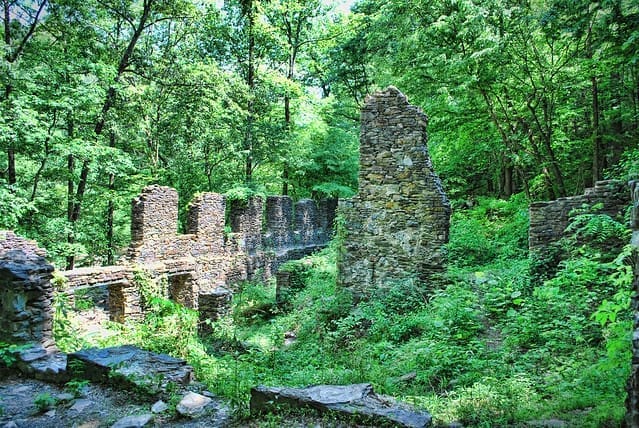
There is a stretch of Sope Creek with paper mill ruins from the 1800s and a trail system most relocation videos completely skip. It is one of my favorite places to send buyers who want to see the area’s character. The Sope Creek and Paper Mill trails are part of the Chattahoochee River National Recreation Area.
The Chattahoochee River access here is a real lifestyle perk. The river runs along the eastern edge and the National Park Service maintains several units within easy reach. The rowing, running and biking communities here are strong due to these gorgeous pathways and trails that make fitness easy and fun.
Another suprise, at least to me, is the number of people who grew up in East Cobb, and then left for college or career, only to circle right back to raise their own kids here. I see it constantly. The thirty something couple buying their first home not far from where one of them went to elementary school. The family relocating from Charlotte or Denver because mom went to Walton and wants her kids in the same district. It is one of the strongest signals you can get about a place. And the schools they came up through have been producing talent for decades. NBA player Shareef Abdur-Rahim led Wheeler to the 1994 Class AAAA state basketball championship before going pro. Rock guitarist Robin Finck of Walton has played with both Nine Inch Nails and Guns N’ Roses. Comedian Brett Butler, also a Wheeler grad, starred in the 1990s sitcom “Grace Under Fire.” There is something to be said for a place people choose twice.
Who should not move to East Cobb?
Be honest with yourself about the real cost of living here before you fall in love with East Cobb. Yes, the homes are expensive. But the lifestyle costs add up just as fast. Sports and activities are a huge part of the culture, and not in a low-key way. East Cobb Baseball is one of the most well-known youth baseball programs in the country, travel teams and club sports are the norm rather than the exception, and families here invest heavily in private coaching, dance, cheer, equestrian, robotics, you name it. If you are coming in expecting to sign up for rec league and call it a day, your kid will likely be playing alongside teammates who have been on travel teams since they were eight, and the social and financial pressure to keep up is real.
Shopping is the other thing to be ready for. Grocery stores and Targets are plentiful, you will not be lacking for the day to day, but local shops and boutique shopping is limited compared to Buckhead, Avalon, or even downtown Roswell. That has been improving the last five years, with more independent shops opening around the Avenue East Cobb and Merchants Walk, but it is still a drive if you want real selection.
Another adjustment for relocators is realizing East Cobb does not have a downtown. No Main Street, no town green, no historic core to walk around on a Saturday morning. “Going out” usually means driving to one of the shopping centers like the Avenue East Cobb, Merchants Walk, or Parkaire, or hopping in the car 10 to 15 minutes to Marietta Square or Canton Street in Roswell for a real downtown feel. Marietta Square in particular is a hidden gem most relocators miss, with a historic town square, a Saturday farmers market in season, the Strand Theatre, and restaurants and live music year round. For a lot of buyers, the no-downtown thing is fine, even part of the appeal. But if your weekends include “let’s just walk somewhere and see what’s open,” you will need to get used to driving to find it.
Diversity is also worth being honest about. ZIP code 30068, the heart of East Cobb, is around 77 percent white per recent census data, making it one of the less diverse parts of metro Atlanta. If a more diverse community matters to you for your kids or for your day to day life, Johns Creek and parts of Roswell will likely feel more like home. There is also a long-standing local reputation, sometimes shorthanded as “East Cobb Snob,” that East Cobb skews country club and a little insular. Most of the families I work with and know here are warm and welcoming and the stereotype is not the whole story, but it exists for a reason and you will hear it. If you are arriving from out of state without an existing network, plan to be intentional about getting plugged into community life. School events, neighborhood pools, sports leagues, all of it. People here are friendly, but the social fabric is already woven, and you will need to find your way into it.
Final thoughts on living in East Cobb
East Cobb is the closest thing I know in metro Atlanta to a suburb that still feels like the nineties suburbs people remember from childhood. Mature trees. Real neighborhoods. Schools that genuinely deliver. The tradeoff is that it is also a car centric, school zone driven market, and your lifestyle here will reflect that.
If you are relocating from out of state or moving from another part of Georgia, and you want to talk through which part of East Cobb or Metro Atlanta actually fits your situation, that is exactly what I do. Call or text 617-605-5939 or set up a no pressure 30 min consult below or stay in touch for my weekly newsletter.
Alison Belknap | Compass Real Estate | alison.belknap@compass.com | 617-605-5939
May 1, 2026


Be the first to comment